Product identity3 min read
A recall photograph can resemble several generations of the same baby product. The decisive details may be a model code, manufacture date, accessory or retailer. Learn how to compare those identifiers and follow the official remedy without treating a familiar picture as proof that a product is unaffected.
Read the guide ↗
Product identity3 min read
A low price is easy to see; missing product history is harder to value. For secondhand baby equipment, the questions are whether you can identify it, obtain its instructions and account for its parts and condition. A seller's reassurance cannot fill a gap that affects safe use.
Read the guide ↗
Sleep equipment3 min read
A crib can look complete while one small connection no longer holds its intended shape. Missing or mismatched fasteners can change gaps and stability. Use the model's parts list and manufacturer support to resolve assembly problems instead of treating the crib as an ordinary furniture repair project.
Read the guide ↗
Sleep equipment3 min read
A mattress advertised as fitting many baby products may list measurements without identifying any tested combination. For sleep equipment, thickness, support and attachment also matter. Learn what a meaningful model-specific compatibility statement looks like and why adding padding to make a surface feel softer creates a different problem.
Read the guide ↗
Sleep equipment3 min read
A bassinet's maximum weight is only one part of its use instructions. Developmental abilities and configuration can also determine when use must stop. Make a transition decision from the actual product warnings instead of waiting for a baby to reach the largest number printed on the box.
Read the guide ↗
Sleep equipment3 min read
A play yard may arrive with a raised bassinet, changing station and another detachable seat. Those parts can have different purposes and limits. Read each mode as its own configuration so that a convenient accessory does not accidentally become a sleep surface or stay attached when the instructions require removal.
Read the guide ↗
Travel and seating3 min read
A bouncer or swing may soothe a baby, but soothing and sleep permission are different claims. A practical setup includes an appropriate sleep space and a way to transfer the baby when sleep occurs. The restraint and a caregiver's nearby presence do not turn a seated product into a crib.
Read the guide ↗
Travel and seating3 min read
An adapter can connect two products mechanically without establishing an approved travel system. The useful question is which exact stroller, adapter and infant car-seat versions the manufacturers identify together. A click, a shared brand or a marketplace compatibility list is not enough to settle that question.
Read the guide ↗
Travel and seating3 min read
Someone who can push a stroller may still be unfamiliar with its locking mechanism or restraint adjustment. A useful handover demonstrates those operations with the stroller empty, then explains the daily checks. Familiarity with a different model does not automatically transfer to the one carrying your child.
Read the guide ↗
Travel and seating3 min read
A carrier can feel secure to the adult while fabric or body position interferes with the baby's breathing. Fit therefore involves the child's visible face and posture as well as buckles. Use the exact instructions and seek qualified guidance for individual concerns rather than learning a complicated carry from a short clip.
Read the guide ↗
Travel and seating3 min read
A tray keeps food near a child; it does not do the job of the chair's safety straps. When comparing high chairs, focus on whether the complete instructed restraint, stable setup and daily operation work for your family. Appearance and a snug tray can hide important gaps in that decision.
Read the guide ↗
Toys and household3 min read
A gate that fits the width of an opening may still be wrong for the location. Stairways, wall materials, extensions and mounting methods affect the decision. Treat the gate as an installed product with specific limits, rather than a freestanding barrier that can be moved anywhere it appears to fit.
Read the guide ↗
Product identity3 min read
An app can show impressive graphs without establishing that its measurements are reliable for a baby's medical needs. Audio, video and vital-sign monitoring raise different questions. Read the claim, authorization and intended user carefully, and keep supervision and safe sleep decisions independent of a device's reassuring display.
Read the guide ↗
Feeding equipment3 min read
A ring can screw onto a bottle while its nipple, valve or seal belongs to a different system. Replacement decisions need more than a visual fit. Keep components traceable to the exact manufacturer's instructions so that a lost or worn piece does not lead to an improvised feeding arrangement.
Read the guide ↗
Feeding equipment3 min read
The key question about a used breast pump is whether the device was designed for more than one user. Looking clean, having new tubing or being described as hospital grade does not answer it. Establish the exact design and manufacturer instructions before considering a secondhand purchase or rental.
Read the guide ↗
Feeding equipment3 min read
A warmer can change a bottle's temperature; it does not make milk safe by itself or reset storage limits. Because warming is optional, the useful comparison begins with your feeding routine and the exact device instructions. Speed claims deserve less attention than the complete handling process around the warmer.
Read the guide ↗
Toys and household3 min read
A bath seat can make a baby look supported, which may encourage an adult to step away. That appearance is misleading. CPSC says bath seats and rings are not safety devices. Evaluate any bathing aid by its exact instructions while keeping continuous adult attention as a separate requirement.
Read the guide ↗
Toys and household3 min read
Small button and coin batteries can be hidden inside familiar toys and household gadgets. The meaningful check is whether the compartment remains properly secured, not whether the product looks child-friendly. Include remotes and adult accessories in the review because a baby's access is not limited to items sold as toys.
Read the guide ↗
Toys and household3 min read
An older child's building set or an adult desk toy can introduce small powerful magnets into a baby's space. The risk is different from ordinary clutter because swallowed magnets can attract inside the body. Plan storage and cleanup around who can access the pieces, not only the age printed on the original box.
Read the guide ↗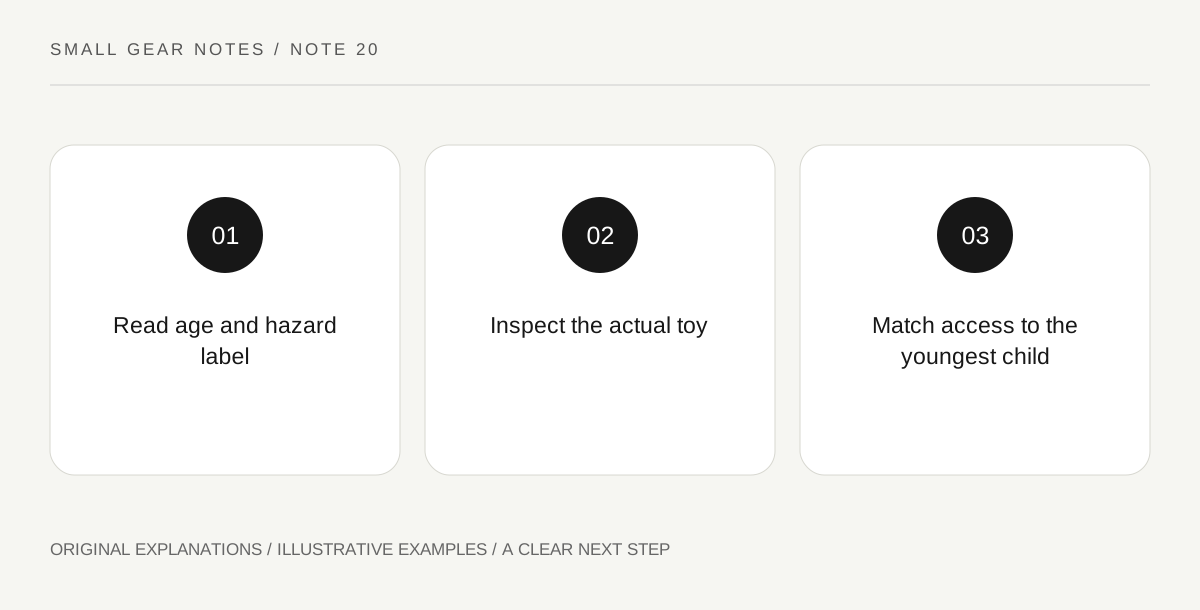
Toys and household3 min read
A baby who reaches early for a sibling's toy has not outgrown that toy's safety warning. Age grading considers product characteristics and hazards, while individual interest is a different observation. Compare the label, actual parts and household access without treating a higher age number as a mark of developmental achievement.
Read the guide ↗