A baby carrier fit check must include the baby's airway
A carrier can feel secure to the adult while fabric or body position interferes with the baby's breathing. Fit therefore involves the child's visible face and posture as well as buckles. Use the exact instructions and seek qualified guidance for individual concerns rather than learning a complicated carry from a short clip.
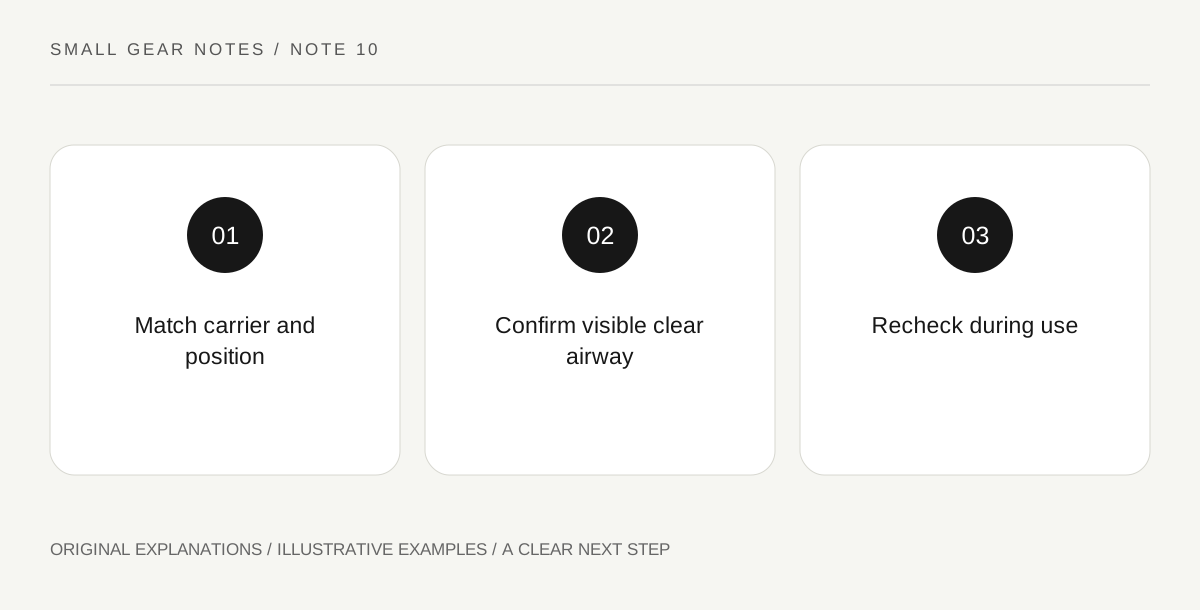
Original explanatory diagram. Read the full method and limitations below.
Match the carrier to the child and carry
Identify whether the product is a sling, wrap, soft carrier or another category, then read its own minimum and maximum requirements. Different carrying positions can require different abilities or adjustments. Do not infer permission from another family's photograph or from a broad age claim on a sales page. Check that all supports and fasteners required for your configuration are present. Ask the manufacturer about product fit and the child's clinician about individual considerations, particularly for very young babies, babies born prematurely or babies with breathing concerns.
Keep the face visible and unobstructed
CPSC's sling guidance emphasizes a face visible to the wearer, uncovered nose and mouth and a chin away from the chest. Fabric, clothing and the adult's body can obstruct breathing; a curled position can also cause difficulty even without a visible covering. Recheck during use because movement and settling can change the fit. Do not cover the carrier opening to block light or wind. Being able to feel the baby's weight against you is not equivalent to seeing and assessing the position described in the instructions.
Distinguish a product adjustment from a change in the child's position. Tightening a shoulder strap may improve how the carrier sits on the adult while leaving the baby's chin or face poorly positioned. Reassess the child directly after each adjustment rather than assuming the adult's improved comfort proves the whole fit. If you cannot see whether the instructed position is maintained, stop and get help. A mirror or another adult may assist learning, but neither substitutes for being able to monitor the baby during actual use.
Practise adjustments before relying on them
Learn fastening and adjustment with help and a safe environment rather than during a rushed departure. Follow the manufacturer sequence for placing and removing the baby, and do not improvise a knot or buckle substitute. If you cannot maintain the instructed position while completing a task, choose another arrangement. A carrier does not make activities involving heat, sharp objects or a fall risk suitable for carrying a baby. Product security and the safety of the adult's activity are separate decisions that both need to make sense.
Notice when the arrangement changes
A coat, another wearer or a different carry can change the fit. Recheck the instructions instead of preserving the previous strap settings as though they were universal. If the baby falls asleep, follow official guidance about moving to an appropriate sleep surface when possible rather than treating the carrier as a replacement bed. If breathing seems abnormal, the baby is difficult to wake or there is another urgent concern, seek emergency medical help. An accessory should never delay responding to the baby because its label sounds reassuring.
A coat changes the view
Illustrative example: a caregiver puts on a thick coat after adjusting a sling indoors and can no longer see the baby's face clearly. They stop and resolve the arrangement before leaving. The earlier successful fit does not establish that the covered outdoor configuration remains appropriate.
Practical checks
Optional checkboxes save only in this browser.
Questions that come up
Does a secure buckle settle every fit issue?
No. Structural fastening and airway position are separate checks. Both must follow the exact instructions.
Can an online video replace the manual?
Use the manufacturer's instructions first. A clip may omit model limits or show a different carry; seek qualified help if you cannot achieve the instructed fit.
References and scope
These sources support the factual background. Examples and exercises are original illustrative teaching material. References do not imply endorsement.
- CPSC sling safety standard and caregiver tips — Visible face, clear airway and chin position during sling use.
- CPSC safe sleep information — Appropriate sleep products, transfer from seated products and a clear firm flat surface.