Inspect the battery compartment before a toy enters the play area
Small button and coin batteries can be hidden inside familiar toys and household gadgets. The meaningful check is whether the compartment remains properly secured, not whether the product looks child-friendly. Include remotes and adult accessories in the review because a baby's access is not limited to items sold as toys.
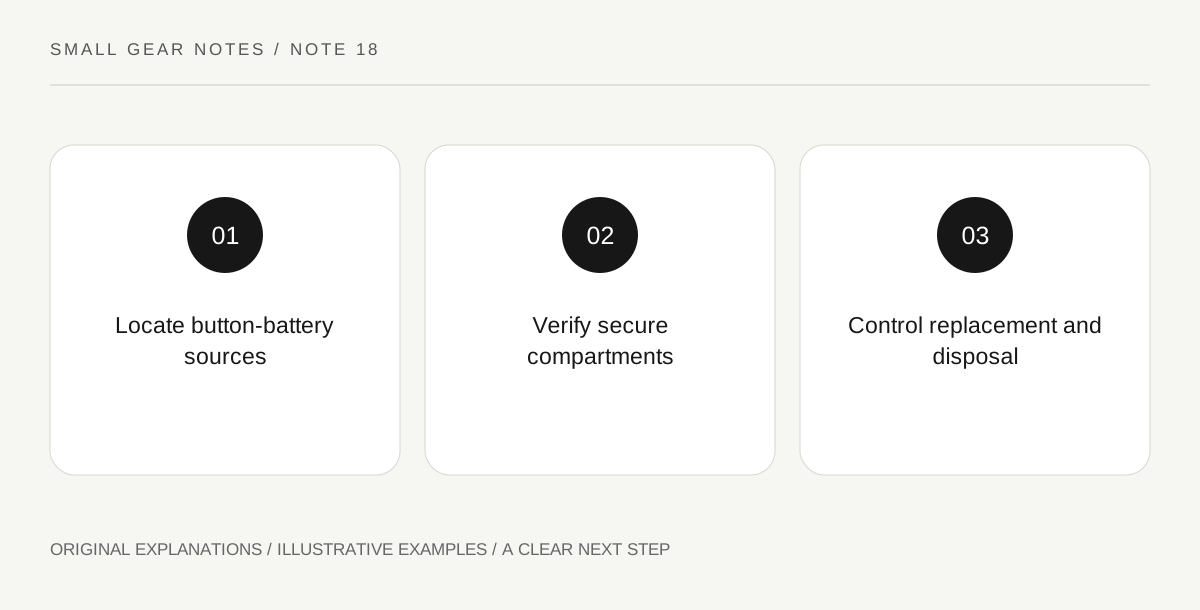
Original explanatory diagram. Read the full method and limitations below.
Find every source in the room
Look beyond the toy basket to remotes, key fobs, lights, scales and other small electronics. Identify which use button or coin batteries without opening compartments near children. New and used batteries both need secure storage away from children. A spent battery can still be dangerous if swallowed, so an empty blister pack or a replacement session deserves attention as well. Do not assume an item belongs in the play area because it has a cheerful design or arrived as a gift for the baby.
Check the closure as a complete system
CPSC advises keeping products with accessible button or coin batteries away from children when the compartments do not have a screw closure securing them. Toy battery compartments must have a secure closure requiring a tool to open. Check that the correct cover and fastener are present, undamaged and closed as intended after replacement. Tape is not an equivalent repair for a missing cover or stripped screw. If the compartment cannot be secured according to the instructions, remove the product from use and contact the manufacturer.
Include visiting adults' belongings in the access plan. A key fob or small remote can fall from a bag onto the floor even when every baby toy has a secured compartment. Ask visitors to place bags and loose electronics in an inaccessible location, and inspect an item promptly if a cover comes off. This is a household storage decision, not a reason to label ordinary guests careless. The objective is to prevent a small cell from entering the play area through an unexpected route.
Control the replacement process
Replace batteries in a clear area with children elsewhere, keeping track of each battery removed and inserted. Put spent cells into a secure container and use appropriate disposal or recycling arrangements rather than leaving them on a table. Read polarity and battery-type instructions rather than stacking cells or using a different size to make a device work. Before returning the product, confirm that the compartment closes fully. Tell other adults that a toy temporarily awaiting a screw is unavailable to children, even if its sound or light still works.
Treat suspected ingestion as urgent
If a child may have swallowed or inserted a button battery, seek immediate medical help; do not wait for symptoms or continue searching the room first. Follow emergency or poison-control instructions for the child's circumstances rather than trying a home remedy from memory. Keep product and battery information available if it can be obtained without delaying care. This article does not give treatment instructions. Prevention checks reduce access but cannot establish what happened after a battery is missing, so uncertainty about exposure needs a prompt professional response.
The missing screw
Illustrative example: a musical toy's battery cover is held on with tape after its screw is lost. The caregiver removes the toy from the play area and requests the correct repair route. Testing whether the tape feels strong does not establish a secured battery compartment.
Practical checks
Optional checkboxes save only in this browser.
Questions that come up
Are used batteries harmless?
No. Keep spent button and coin batteries inaccessible to children and arrange appropriate disposal or recycling.
Can tape secure the cover temporarily?
Do not treat tape as a substitute for the specified closure. Keep the product away from children until the compartment is correctly secured.
References and scope
These sources support the factual background. Examples and exercises are original illustrative teaching material. References do not imply endorsement.
- CPSC button and coin batteries — Secured battery compartments, loose battery hazards and urgent response.