Why a bath seat is not a supervision device
A bath seat can make a baby look supported, which may encourage an adult to step away. That appearance is misleading. CPSC says bath seats and rings are not safety devices. Evaluate any bathing aid by its exact instructions while keeping continuous adult attention as a separate requirement.
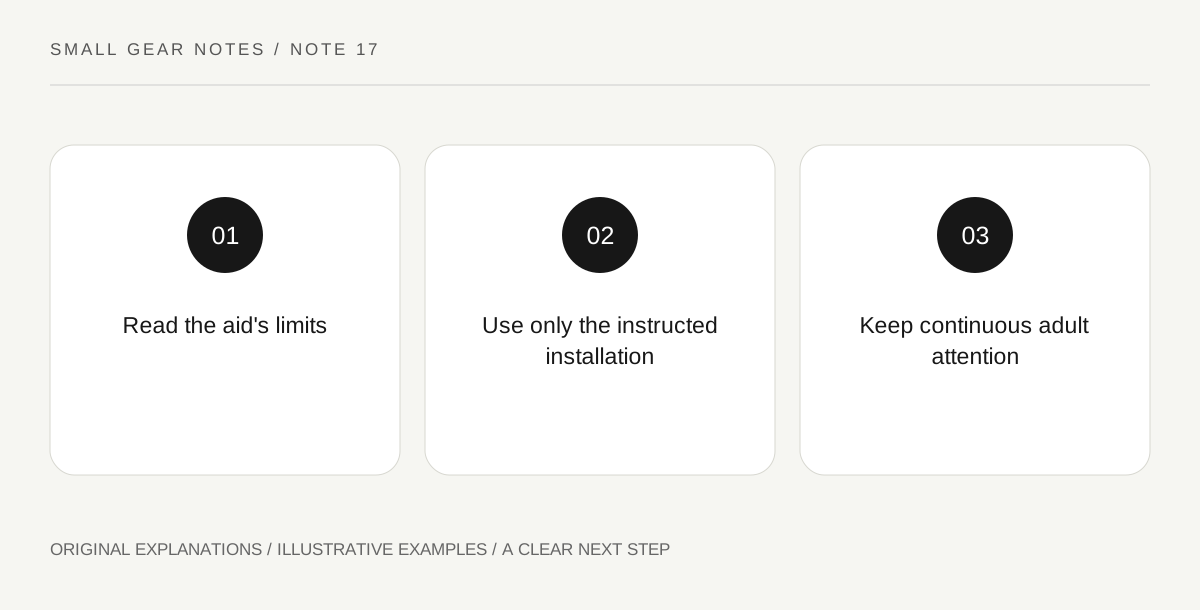
Original explanatory diagram. Read the full method and limitations below.
Read the product's actual purpose
Identify whether the product is a bath seat, infant tub or another bathing aid, and locate its model-specific instructions. A seat may require particular child abilities and have an upper use limit; its supportive shape does not grant permission for every baby. Check recall information and inspect the actual unit for damage or missing components. A photograph showing a smiling child in water is not evidence that the product prevents drowning. Avoid marketing that suggests an adult can complete another task while the aid holds the child.
Examine the installation requirements
Read which tub surfaces, dimensions and positions the manufacturer permits. Suction cups or supports need the exact installation conditions described; do not assume they hold equally on textured, curved or dirty surfaces. Do not add a towel underneath unless the instructions specifically permit that arrangement. A seat that seems stable when empty can still create hazards in use, and a homemade restraint cannot make an incompatible arrangement suitable. If the instructions cannot be followed in your tub, choose an appropriate alternative rather than adapting the product yourself.
Read claims such as anti-slip and secure suction narrowly. They may describe a feature under specified conditions, but they cannot establish that an adult may release attention or that the child cannot slide or tip. When asking the manufacturer about a feature, state your actual tub surface and the child's relevant abilities rather than requesting a general safety reassurance. If the product's permitted use is unclear, do not use the bath itself as a trial. Resolve the instructions before placing the child in water.
Keep the adult's role continuous
CPSC advises never leaving a young child alone in or near water, even briefly, or under a sibling's supervision. An adult needs to remain present and attentive, not just within hearing distance. Prepare the necessary items before bathing so a missing towel does not create a reason to step away. If the adult must leave, take the child out of the water and with them in a safe manner. A phone call, delivery or another child needing help does not change this requirement.
Watch for misplaced reassurance
A bath seat does not become more protective because it has a high back, a large tray or many suction cups. Those are product features to assess within the manual, not a drowning-prevention guarantee. Keep water-related safety decisions separate from product comfort and storage convenience. Tell every caregiver explicitly that the aid does not supervise the child. After bathing, empty water and store the product as directed, checking condition before the next use. If something loosens or breaks, stop using the aid rather than relying on closer watching to compensate.
The towel at the door
Illustrative example: a caregiver realizes a towel is outside the bathroom while the baby is in a bath seat. They do not leave the child to fetch it. They take the child safely out of the water and with them, then reorganize supplies before any future bath.
Practical checks
Optional checkboxes save only in this browser.
Questions that come up
Do suction cups make a seat a safety device?
No. They may be part of the installation, but they do not prevent drowning or replace continuous adult attention.
Can an older sibling watch for one minute?
CPSC advises against leaving a young child in the bath under a sibling's supervision. An attentive responsible adult must remain with the child.
References and scope
These sources support the factual background. Examples and exercises are original illustrative teaching material. References do not imply endorsement.
- CPSC baby safety checklist — Missing crib hardware, high-chair restraints, bathing aids and small-object hazards.
- CPSC durable infant or toddler products — Product categories, registration and mandatory safety requirements.