A stroller handover should include the fold lock and the harness
Someone who can push a stroller may still be unfamiliar with its locking mechanism or restraint adjustment. A useful handover demonstrates those operations with the stroller empty, then explains the daily checks. Familiarity with a different model does not automatically transfer to the one carrying your child.
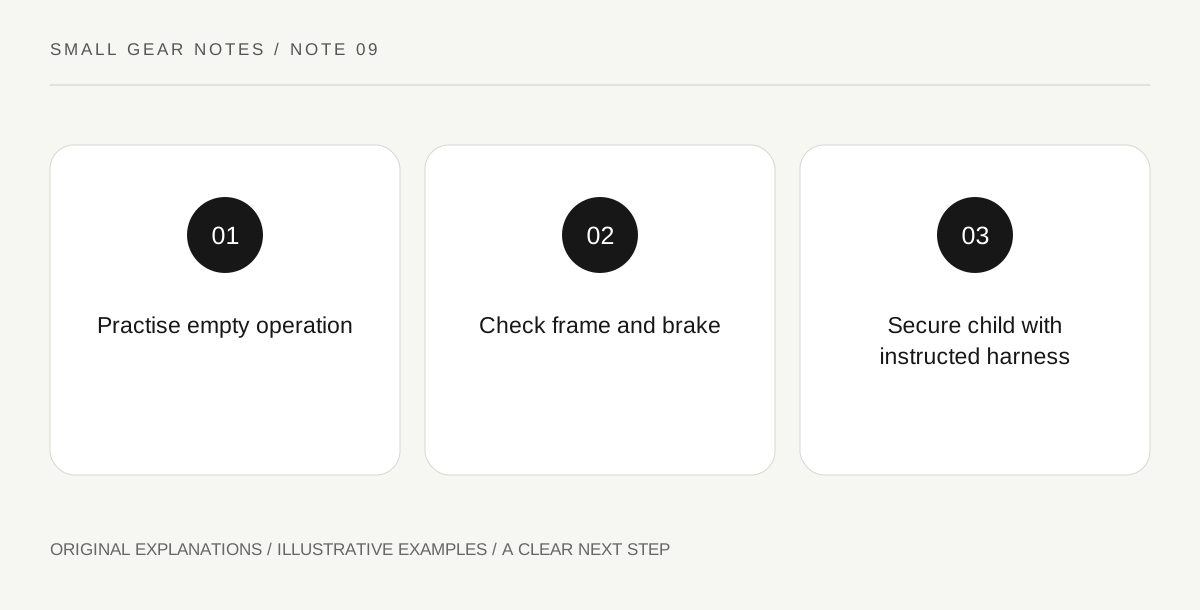
Original explanatory diagram. Read the full method and limitations below.
Demonstrate the empty fold and unfold
Choose a level area away from the child and other people. Use the exact manual to show the fold sequence, the transport latch and the lock that holds the frame open for use. Those can be different mechanisms. Keep hands clear of moving joints and do not ask someone to learn the operation while holding the baby. If a lock does not engage as described, stop and investigate through the manufacturer rather than treating a forceful push or improvised tie as an acceptable solution.
Explain restraint adjustment as an operation
Show how every required strap fastens and how the adjustment works for the child's current size. CPSC warns that an unrestrained infant can become entrapped or strangled in a stroller. A tray or bumper bar is not a substitute for the harness. Read the manual's instructions about seat recline and permitted child abilities as well as weight. After a cover has been removed for cleaning, confirm the restraint was rethreaded correctly before the next ride. A neat-looking cover can conceal a routing error.
Explain storage mode as well as riding mode. A folded stroller may have its own latch and transport instructions, and a loose frame can open unexpectedly while being lifted. Show where to hold it according to the manual, and keep the folded unit from becoming a climbing or pinch hazard in a doorway. This gives the caregiver a complete beginning and ending to the routine. It also prevents the common assumption that the only important lock is the one checked immediately before the child rides.
Review brakes and permitted loading
Demonstrate the parking brake and the checks the manufacturer specifies before use. Explain which storage areas have load limits and where bags may be carried. Hanging a heavy bag from a handle can affect stability; do not assume a convenient hook is an approved attachment. Keep the child's fingers and feet away from wheels and moving parts, and stay with the stroller when stopped. A brake helps with the product's intended task but does not make a moving escalator or another prohibited location appropriate.
Agree on the stop-use response
Tell the next caregiver what to do if a wheel becomes loose, a buckle no longer closes or the frame behaves differently. The response should be to stop using the affected equipment and arrange a suitable alternative, not to continue because the destination is close. Keep the model label and manual location available for support or recall checks. An occasional inspection should include the condition of restraints, frame and wheels, especially after transport. Describe observed faults precisely so the manufacturer can distinguish wear from incorrect setup.
The wrong lock assumption
Illustrative example: a grandparent hears a click when unfolding a stroller and assumes it is ready. In an empty demonstration, the parent shows that the sound came from the storage latch; the manual requires a separate frame-lock check. Practising the complete sequence exposes the misunderstanding before a child is placed inside.
Practical checks
Optional checkboxes save only in this browser.
Questions that come up
Is the bumper bar a restraint?
No. Use the harness according to the manual. Bars and trays do not replace the restraint system.
Can a caregiver learn while walking?
Teach unfamiliar operations with the stroller empty in a clear area first. Questions about locks or straps should be resolved before the child rides.
References and scope
These sources support the factual background. Examples and exercises are original illustrative teaching material. References do not imply endorsement.
- CPSC stroller guidance — Stroller folding, stability, restraints, brake and latch hazard categories.
- CPSC infant stroller restraint alert — Entrapment and strangulation risks when stroller restraints are not used.