Before buying a bottle warmer, separate warming from safe preparation
A warmer can change a bottle's temperature; it does not make milk safe by itself or reset storage limits. Because warming is optional, the useful comparison begins with your feeding routine and the exact device instructions. Speed claims deserve less attention than the complete handling process around the warmer.
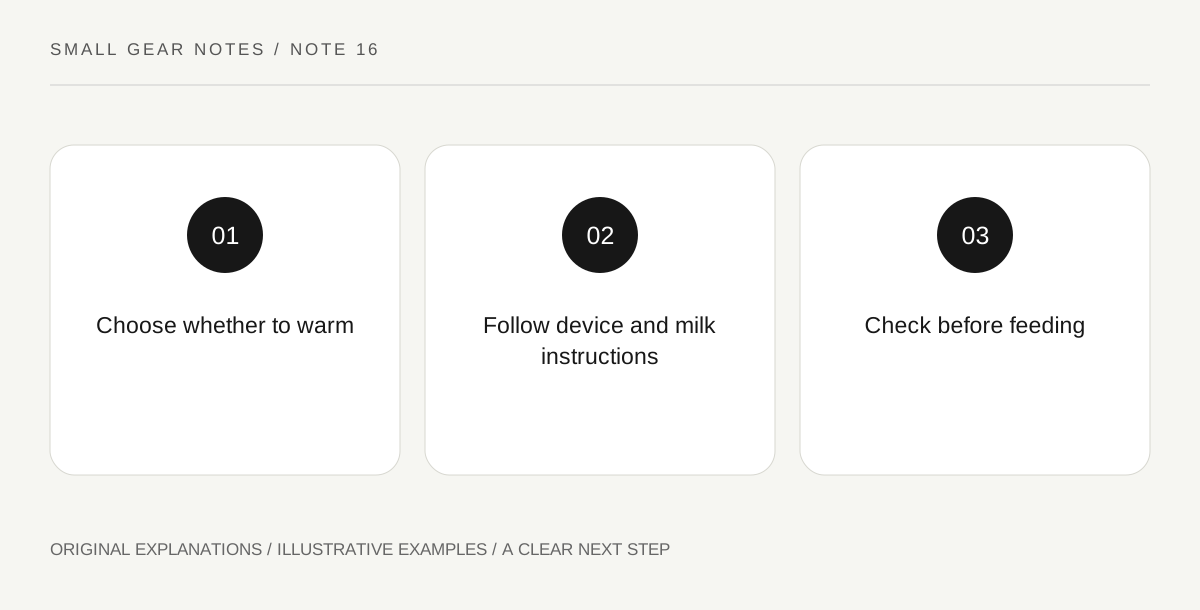
Original explanatory diagram. Read the full method and limitations below.
Ask whether warming is needed
CDC states that breast milk does not need to be warmed and can be served cold or at room temperature. Some families prefer warming, but a warmer is not a required sign of careful feeding. Discuss any individual feeding or medical requirements with the child's clinician. If warming fits your routine, compare it with the official warm-water method before buying another device. The decision is about practical handling, not whether a warmer can deliver an advertised sleep or digestion benefit that has not been established for your child.
Read what the device actually does
Check the manual for the compatible bottle materials, sizes, starting conditions and permitted contents. A device may use different instructions for a refrigerated bottle and another starting temperature. Do not assume a familiar cycle applies to a new bottle shape or volume, and never heat a closed container contrary to the instructions. Keep hands clear of steam and hot water. Position the device and its cord where a child cannot reach or pull them. A countdown display reports a cycle; it does not independently prove that every part of the milk has the intended temperature.
Make the handover include the milk's identity and history, not only the warmer setting. A second caregiver needs to know which child's milk it is, when it was expressed or prepared as applicable, and whether it has already been warmed or offered. A sticky note saying 'cycle two' cannot carry that information. Keep a simple label and communicate the relevant time limits using current official guidance. The machine should fit into the handling process rather than become the household's only record of what happened to the bottle.
Keep milk handling rules intact
Warming does not erase time already spent in storage, make an unfinished bottle fresh again or permit repeated cycles whenever the milk cools. Follow current CDC guidance for the type of milk, storage history and whether feeding has begun. Label expressed milk so the caregiver knows its history before placing it in the device. Avoid microwaves for warming milk because uneven heating can create hot spots. This restriction is different from a manufacturer-approved microwave sanitizing process for empty equipment; do not confuse those two tasks.
Evaluate operation and care together
Read how to empty, clean and maintain the warmer and what must be done between uses. Mineral buildup or an inaccessible reservoir can make a fast device awkward in daily practice. Keep the instructions with it so a second caregiver does not improvise settings from memory. Test milk temperature as official guidance describes before feeding and keep the baby's needs, rather than the machine's completion sound, at the centre of the routine. If a device leaks, overheats or has damaged electrical parts, stop using it and contact the manufacturer.
The late bottle
Illustrative example: a caregiver finds a partially used bottle and considers running another warming cycle. They check when feeding began and apply the relevant milk-handling limits instead. The warmer cannot restart the clock or turn uncertain storage history into a safe bottle.
Practical checks
Optional checkboxes save only in this browser.
Questions that come up
Does a warmer sanitize milk?
Do not assume that it does. A warming cycle is not a substitute for safe preparation, storage and feeding-item care.
Can I use a microwave for a quick warm-up?
CDC advises against microwaving breast milk or infant formula because uneven heating can create hot spots. Use the appropriate official warming method instead.
References and scope
These sources support the factual background. Examples and exercises are original illustrative teaching material. References do not imply endorsement.
- CDC breast milk storage and preparation — Warming is optional, warm-water methods and avoiding microwaves.
- CDC infant feeding item hygiene — Separate components, manufacturer care instructions and inspection of feeding equipment.