What an incomplete history means for secondhand baby gear
A low price is easy to see; missing product history is harder to value. For secondhand baby equipment, the questions are whether you can identify it, obtain its instructions and account for its parts and condition. A seller's reassurance cannot fill a gap that affects safe use.
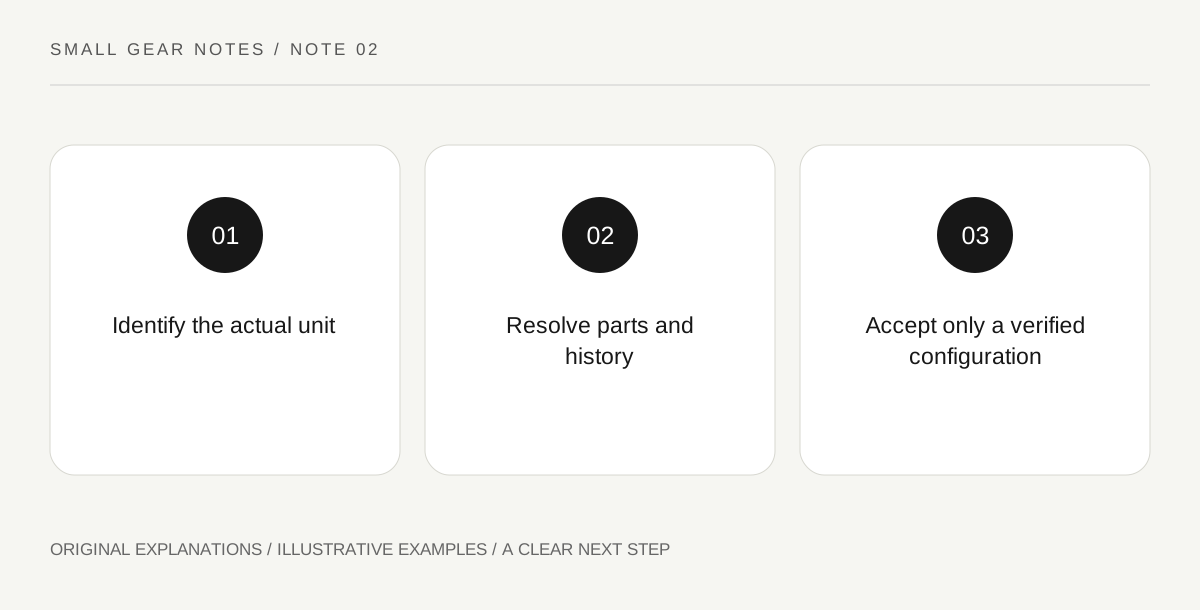
Original explanatory diagram. Read the full method and limitations below.
Separate identity from appearance
Start with the exact manufacturer, model and production information. A cleaned fabric cover and fresh paint cannot establish whether an item meets current requirements or has been recalled. Ask for photographs of labels before travelling to collect it, and search official recall information yourself. A seller may honestly remember the wrong model or describe a product by its most familiar nickname. If the label has been removed or painted over, treat the resulting uncertainty as an unresolved decision, rather than a reason to guess from an online photograph.
Account for alterations and missing pieces
Ask whether anything has been repaired, substituted, removed or added. Compare the physical item with the parts list in the exact manufacturer's manual. Straps, fasteners, supports, pads and locking pieces can be safety components even when a product appears to stand normally without them. Avoid deciding that a hardware-store bolt or a cushion from another model is equivalent because it fits an opening. For an incomplete product, get the manufacturer's answer about an approved replacement before agreeing to use it.
Consider the cost of making the item verifiable as part of its price. A missing approved pad, unavailable restraint or discontinued replacement connection can make a cheap purchase impractical. Decide which information you need before collection, and leave enough time to obtain it without a seller waiting beside you. This is especially helpful at a garage sale, where urgency can encourage accepting a story instead of the product's identity. A photograph of the label is a more useful first request than an assurance that everything worked.
Choose which unknowns you can resolve
Some gaps are straightforward: a manufacturer may provide the correct manual using the label. Others cannot be resolved by a brief inspection, including an uncertain modification or concealed structural damage. Different categories require different history checks; do not extend a rule for a plastic toy to a car seat or sleep product. For a car seat, consult NHTSA and its manufacturer about crash history, expiration and missing parts. A bundle price should not pressure you to accept every item in the bundle as usable.
Make the handover a verification point
Inspect the actual product before payment or accepting a gift. Compare it with the photographs, check that labels remain readable and confirm the listed components are present. Keep the transaction details and download instructions for the exact unit. A free item deserves the same review as a purchased one because price does not change a hazard. If the history remains inadequate, declining it can be the practical outcome. Do not donate or sell a recalled item onward as though another caregiver can simply decide to ignore the recall.
Two items in one bundle
Illustrative example: a family can identify a used high chair and obtain its manual, but the accompanying bassinet has no label and an improvised pad. They assess the high chair separately and decline the unidentified bassinet. Accepting one item does not make the whole bundle suitable.
Practical checks
Optional checkboxes save only in this browser.
Questions that come up
Is a gift exempt from these checks?
No. A known giver can provide useful history, but an item still needs identification, current recall review, complete parts and appropriate condition.
Can a clean appearance replace a manual?
No. Cleaning does not explain configuration, assembly order, use limits or approved components. Get the correct instructions before deciding whether the product can be used.
References and scope
These sources support the factual background. Examples and exercises are original illustrative teaching material. References do not imply endorsement.
- CPSC recall database — Exact product identification, affected production ranges and official remedies.
- CPSC resale and thrift guidance — Recall checks and safety responsibilities for secondhand products.
- CPSC durable infant or toddler products — Product categories, registration and mandatory safety requirements.
- NHTSA car seat safety and used-seat checklist — Used-seat identity and history checks and exact vehicle and seat instructions.