Why a missing crib fastener is not a hardware-store problem
A crib can look complete while one small connection no longer holds its intended shape. Missing or mismatched fasteners can change gaps and stability. Use the model's parts list and manufacturer support to resolve assembly problems instead of treating the crib as an ordinary furniture repair project.
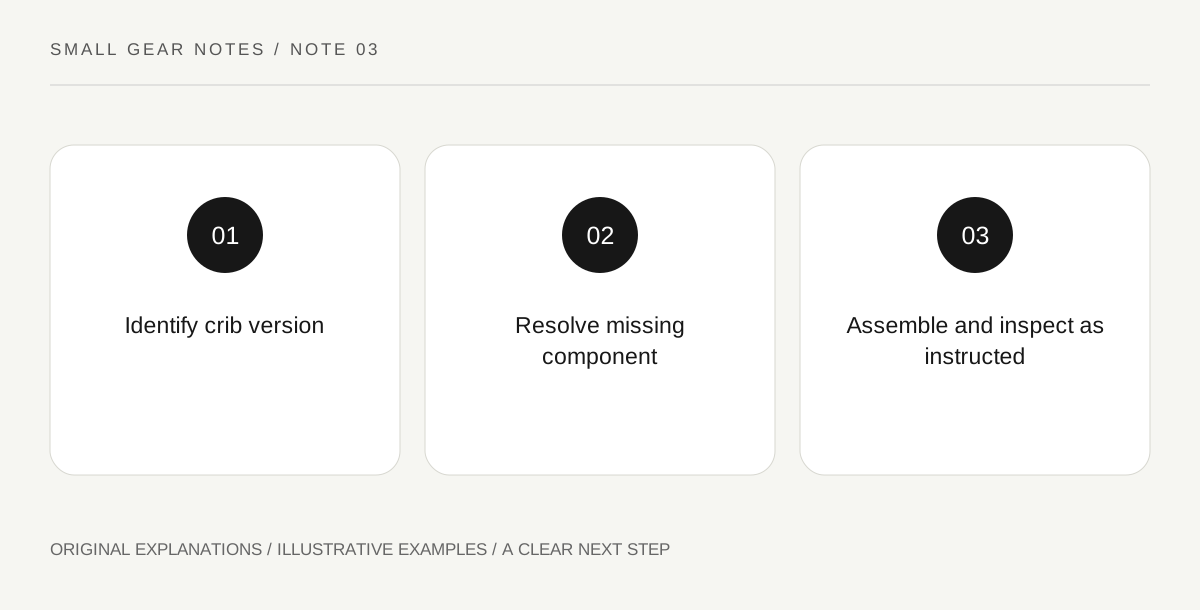
Original explanatory diagram. Read the full method and limitations below.
Use the exact assembly map
Locate the crib's model and manufacture information, then obtain the manual for that version. Similar-looking models can use different rails, support brackets or fasteners. Lay out the listed parts before assembly and compare the quantities and shapes with the diagram. Work where you can see small pieces and keep children away from the assembly area. If a labelled part is absent or damaged, stop rather than completing the structure with a substitute. A crib that stands upright has not necessarily passed its assembly checks.
Understand why connections matter
CPSC warns against cribs with missing, broken or loose parts because openings can form that create entrapment or suffocation hazards. The connection affects more than how much the crib wobbles when an adult pushes it. A bolt's length, thread, head and matching insert can determine how components remain aligned. Adding washers, glue or another bracket changes that system. This is why an apparently clever household repair is not evidence that the crib performs as intended under repeated child movement.
Pay attention to the distinction between an assembly fastener and a conversion component. A crib advertised as convertible may need a separate approved kit for a later bed mode. Do not use pieces from that future kit to replace missing components in the infant configuration. When requesting parts, describe the configuration you intend to assemble now and quote the manual's part identifier. That avoids receiving a legitimate component that belongs to the same product family but has a different structural role.
Ask for model-specific replacement support
Contact the manufacturer with clear label and connection photographs. Ask for the approved part, assembly instructions and any recall action affecting the unit. Do not order a generic kit solely because a seller lists the brand name. If the manufacturer cannot identify a replacement or says the product should no longer be used, arrange a suitable alternative sleep space. Avoid rebuilding a damaged slat or converting an old drop-side crib through an improvised immobilization method. Current standards and official recall remedies matter alongside the original manual.
Keep inspection distinct from modification
After correct assembly, follow the manual's inspection and tightening guidance. Check again after moving or reassembling the crib, since a move can reveal loosened or lost hardware. Do not overtighten to compensate for a damaged connection, and do not cover a defect with fabric or a bumper. Record the model and store its instructions where another caregiver can find them. A routine inspection should confirm that the approved structure remains intact; it should not become a series of increasingly elaborate repairs to keep an unsuitable product in service.
A bolt that appears to fit
Illustrative example: a caregiver finds a bolt of roughly the same length in a drawer. Instead of installing it, they send the crib model and missing-part diagram to the manufacturer. Until the approved part and instructions arrive, the baby uses another appropriate sleep product. A matching diameter alone does not establish compatibility.
Practical checks
Optional checkboxes save only in this browser.
Questions that come up
Can I borrow hardware from another crib?
Only use components specifically approved for your exact model. Similar appearance or a shared brand does not establish that fasteners and connection systems are interchangeable.
How often should I tighten everything?
Follow the model's instructions and inspect after moving or reassembly. A connection that will not remain secure needs manufacturer assessment, not repeated force.
References and scope
These sources support the factual background. Examples and exercises are original illustrative teaching material. References do not imply endorsement.
- CPSC recall database — Exact product identification, affected production ranges and official remedies.
- CPSC baby safety checklist — Missing crib hardware, high-chair restraints, bathing aids and small-object hazards.