Choose a child gate for its location and mounting instructions
A gate that fits the width of an opening may still be wrong for the location. Stairways, wall materials, extensions and mounting methods affect the decision. Treat the gate as an installed product with specific limits, rather than a freestanding barrier that can be moved anywhere it appears to fit.
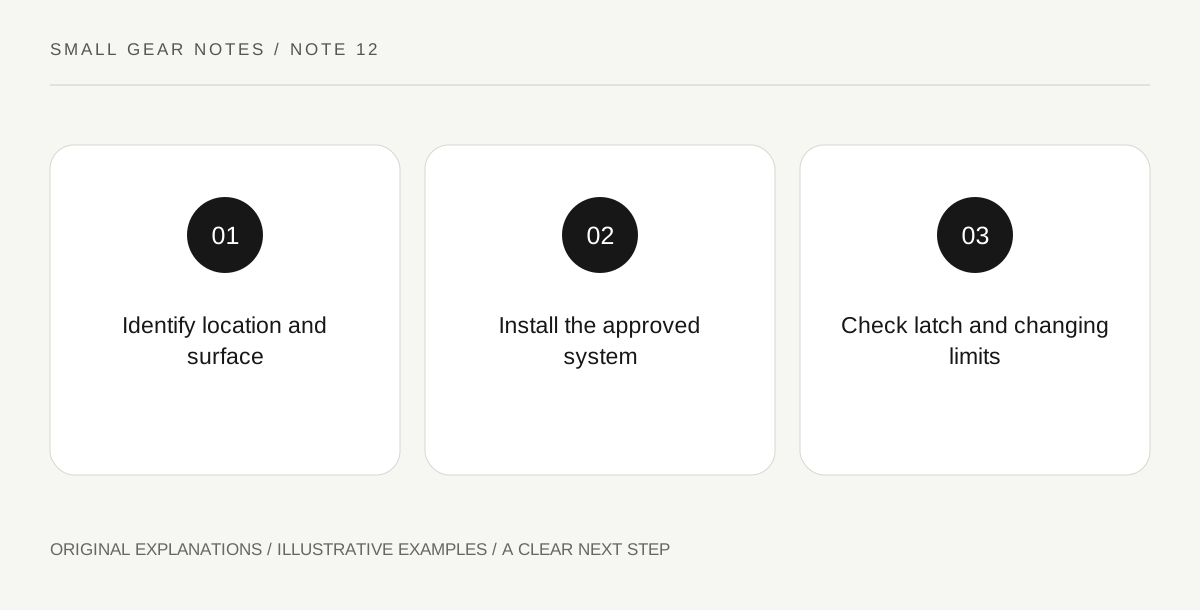
Original explanatory diagram. Read the full method and limitations below.
Describe the opening before buying
Measure the opening where the gate will actually mount and note the wall, banister and skirting-board arrangement. Identify whether it is a stair location or another doorway. Read the manufacturer's permitted width range with any specifically approved extensions, rather than adding widths from unrelated accessories. A product labelled for pets is not a child safety gate. CPSC advises using appropriate child gates and hardware-mounted gates at the top of stairs. Do not rely on pressure alone at that location because a frame appears firmly wedged.
Check the mounting surface and hardware
Follow the exact installation instructions, including where the mount must be fixed and which supplied pieces are required. A wall cup, spacer, extension or banister kit can have a specific purpose; an apparently minor missing component may affect security. Do not invent a mounting solution with cable ties or a decorative rail if the manufacturer does not permit it. If the required surface is unavailable, ask about an approved solution or obtain qualified installation help. A correctly measured opening cannot compensate for an unsuitable support.
An installation that works in one home may not transfer unchanged to another. Skirting boards, wall material and opening width can alter the required mounting arrangement even when both openings look standard. Keep all approved hardware with a gate that is moved, and repeat the full installation procedure at the new location. Do not preserve a partly assembled setting merely to save time. If a rental home limits drilling, resolve the property question and find an appropriate safety arrangement; that limitation does not make pressure mounting suitable at stair tops.
Make the latch usable by every adult
Practise opening, closing and confirming the latch without a child nearby. A gate that adults habitually leave open because it is awkward does not serve its intended role. Do not step over a closed gate while carrying a baby, and keep the swing direction and clearance consistent with its instructions. Tell visitors how it works rather than assuming that a closed-looking panel is latched. At stairs, consider the whole route, including lighting and clutter, so the barrier does not become another obstacle during carrying.
Reassess as the child and installation change
Inspect the mounted gate as instructed and after it has been moved or knocked. Check for loosened hardware, damaged parts and changes in the opening. Follow the product's age, height and ability limits; a child who can climb or open it may need a different safety arrangement. Do not extend use by stacking gates or adding homemade panels. A gate reduces access to a hazard while properly used, but it does not replace supervision or eliminate other routes to the same area. Keep the model details for recall checks.
One gate, two locations
Illustrative example: a pressure-mounted gate works within its instructions in a level doorway, but a family wants to move it to the top of a staircase. They choose an appropriate hardware-mounted product and approved installation instead. The same width does not make the two locations equivalent.
Practical checks
Optional checkboxes save only in this browser.
Questions that come up
Can a pet gate serve the same purpose?
No. Use a product intended as a child safety gate and suitable for that location.
Can I add a homemade spacer?
Do not improvise mounting components. Ask the manufacturer for an approved solution or choose a gate compatible with the actual opening.
References and scope
These sources support the factual background. Examples and exercises are original illustrative teaching material. References do not imply endorsement.
- CPSC childproofing devices — Child safety gates, hardware mounting for stairs and limits of safety devices.
- CPSC durable infant or toddler products — Product categories, registration and mandatory safety requirements.