Verify the whole stroller and car-seat adapter combination
An adapter can connect two products mechanically without establishing an approved travel system. The useful question is which exact stroller, adapter and infant car-seat versions the manufacturers identify together. A click, a shared brand or a marketplace compatibility list is not enough to settle that question.
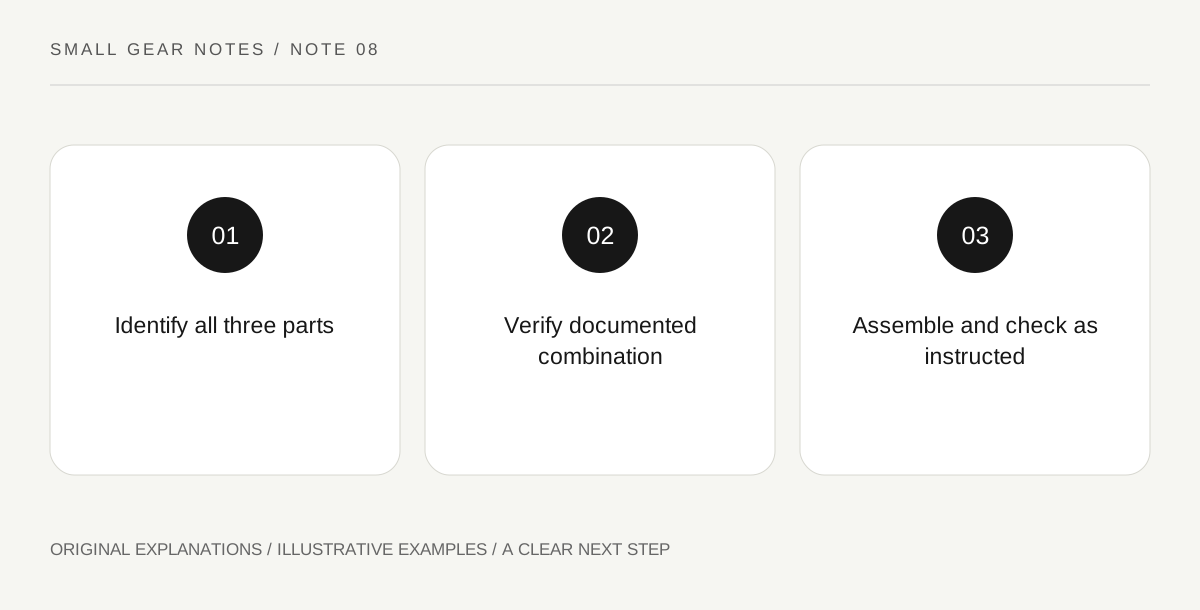
Original explanatory diagram. Read the full method and limitations below.
Write down three separate identities
Record the stroller model and version, the adapter's part number and the infant car-seat model. Include production information when a manufacturer distinguishes generations. A retailer may shorten the name and omit a suffix that matters to compatibility. Ask for photographs of actual labels when buying used, rather than relying on a stock image of a similar arrangement. Keep the car seat's vehicle-use instructions separate: permission to attach it to a stroller does not establish correct installation in your particular vehicle.
Use manufacturer instructions for the configuration
Find the stroller and adapter manuals and check the compatible-seat list for the exact version. Manufacturer manual libraries, such as Chicco's, illustrate why instructions are organized by product and component rather than by a broad word like travel system. This is a method for finding evidence, not a recommendation for a brand. If the adapter documentation and the seat documentation conflict, contact the manufacturers before use. Do not broaden a list yourself because another seat looks similar or seems to use the same latch.
Make a compatibility question specific enough for support to answer. Include clear photographs of each label and ask whether the named stroller, named adapter part and named seat version form an approved configuration. Asking only whether the brand works with your stroller can invite a reply about a different product family. Keep the written response with the manuals, and ask again if a replacement part has a different number. Compatibility evidence belongs to the combination actually used, rather than to a collection of generally familiar components.
Follow every required setup step
An approved combination can still be assembled incorrectly. Read which seat, canopy or other component must be removed or repositioned, the required orientation and the locking checks. Perform those checks according to the manual with a clear work area, keeping the baby safely elsewhere during initial setup. Avoid testing compatibility by forcing a latch or adding a strap. A mechanical sound may show that something moved into place; it does not prove the combination is approved or that every attachment point engaged.
Keep the travel role within its boundary
Use the stroller's own restraints and the car seat's harness according to the applicable instructions. Observe each product's use limits, including which component ends the configuration's permission first. At the destination, do not use the mounted car seat as the baby's routine sleep space; follow guidance to move a sleeping infant to an appropriate sleep product. Store the adapter's identity and instructions with the stroller so a second caregiver does not substitute a visually similar part. Recheck the arrangement when any component is replaced.
A nearly matching model name
Illustrative example: an adapter lists Seat A, but the family's label says Seat A Plus. The family asks the manufacturer to confirm that exact version and waits for an answer rather than relying on a seller's video showing it clicking in. The suffix is an unresolved fact, not a harmless detail.
Practical checks
Optional checkboxes save only in this browser.
Questions that come up
Is same-brand equipment always interchangeable?
No. Compatibility can depend on model, generation and adapter. Use the manufacturer's specific documentation for all components.
Can I add a strap if the seat feels loose?
Do not improvise a connection. Stop use and resolve the approved configuration and assembly instructions with the manufacturer.
References and scope
These sources support the factual background. Examples and exercises are original illustrative teaching material. References do not imply endorsement.
- CPSC stroller guidance — Stroller folding, stability, restraints, brake and latch hazard categories.
- Chicco product manuals — Manufacturer-level model identification and configuration-specific instructions; an example, not an endorsement.
- CPSC safe sleep information — Appropriate sleep products, transfer from seated products and a clear firm flat surface.