Why a high-chair tray is not the restraint system
A tray keeps food near a child; it does not do the job of the chair's safety straps. When comparing high chairs, focus on whether the complete instructed restraint, stable setup and daily operation work for your family. Appearance and a snug tray can hide important gaps in that decision.
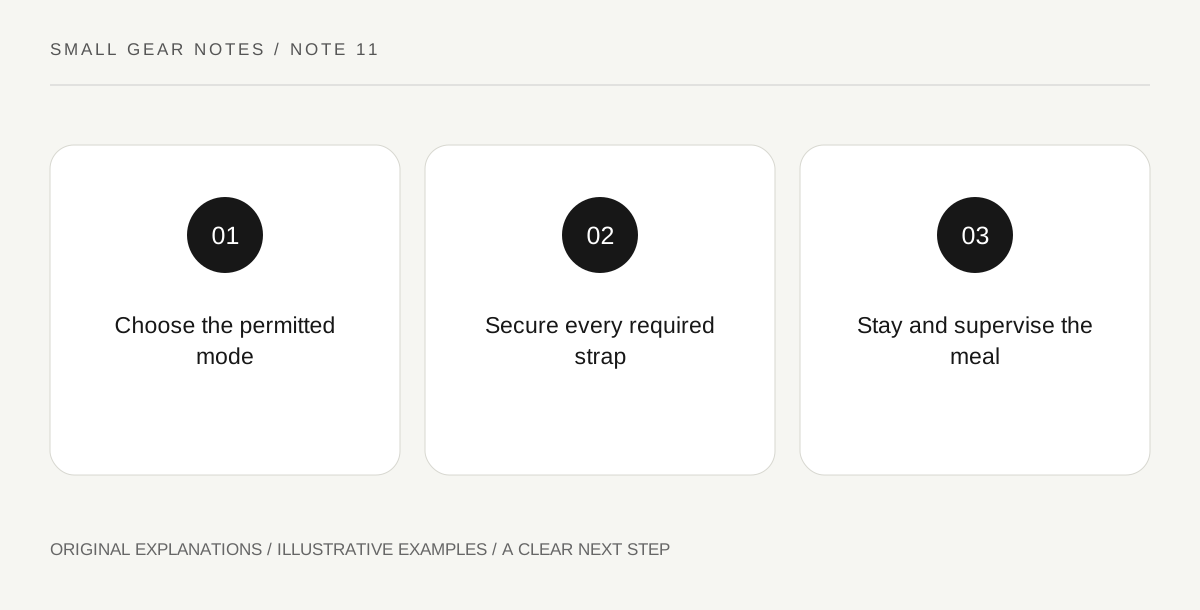
Original explanatory diagram. Read the full method and limitations below.
Read the chair's entry and exit limits
Check the exact manual for the child's required abilities, weight and permitted configuration. Some products change from an infant arrangement to a toddler chair, and the restraint requirements may change with the mode. A broad 'grows with your child' claim does not tell you which mode is appropriate today. Identify any required insert, support or strap before placing the child inside. If instructions are missing, do not guess from a picture of a similarly shaped chair. Obtain the model-specific manual or choose an identifiable alternative.
Use every required restraint component
CPSC advises always using all high-chair safety straps and staying with the baby. A tray, narrow opening or a child who usually sits calmly is not a substitute. Follow the manual for routing and adjustment, keeping the child seated as intended. If straps have been removed for cleaning, check reassembly before the next meal. Avoid threading them through a convenient hole that differs from the illustration. A damaged buckle or missing crotch strap needs an approved resolution; tightening the tray cannot compensate for a missing restraint.
When buying used, check that the restraint belongs to the exact high chair and is not an unrelated replacement threaded into existing holes. Compare attachment points, buckle pieces and strap routing with the manual. An apparently complete set can still be wrong for that seat. Ask the manufacturer if any piece is uncertain, and keep the chair out of use while resolving it. This makes restraint verification a component check, rather than a superficial judgment that a few straps are present.
Assess stability in the actual location
Place the chair on the instructed level surface and check that folding legs or other locks are fully engaged. Consider what the child could push against, reach or pull, including the dining table, tablecloth and nearby cords. Do not use the chair to place a child at an elevated edge or leave them unattended while food is prepared elsewhere. Loading a bag on the chair can also change how it behaves. The product's stability depends on the real arrangement, not just the wide base shown in a catalogue photograph.
Treat tray removal as a transition
Decide how the adult will support the routine when fastening straps, fitting the tray and lifting the child out. Practise unfamiliar releases with the chair empty first. If another caregiver removes the tray while the child remains seated, the restraint still needs to be used correctly. Keep fingers away from moving joints and do not let a child stand on the seat to make removal easier. Stop using the chair if a latch, support or restraint fails, and check the model for recall or replacement information.
A meal without the tray
Illustrative example: a caregiver removes the tray so the child can sit nearer the table. The manual still requires the same restraint in that mode, so all straps remain correctly fastened. Moving the tray changes access to food, not the need to prevent a fall or entrapment.
Practical checks
Optional checkboxes save only in this browser.
Questions that come up
Can a tight tray replace a missing strap?
No. The tray is not a substitute for the restraint system. Resolve missing or damaged components through the manufacturer before using the chair.
May I step away briefly while the child eats?
Stay with the child. High-chair straps are part of safe use, not permission to leave a child unattended.
References and scope
These sources support the factual background. Examples and exercises are original illustrative teaching material. References do not imply endorsement.
- CPSC high chair guidance — Tray disengagement, falls, entrapment and tip-over hazards.
- CPSC baby safety checklist — Missing crib hardware, high-chair restraints, bathing aids and small-object hazards.