Plan the move from a bouncer before the baby becomes sleepy
A bouncer or swing may soothe a baby, but soothing and sleep permission are different claims. A practical setup includes an appropriate sleep space and a way to transfer the baby when sleep occurs. The restraint and a caregiver's nearby presence do not turn a seated product into a crib.
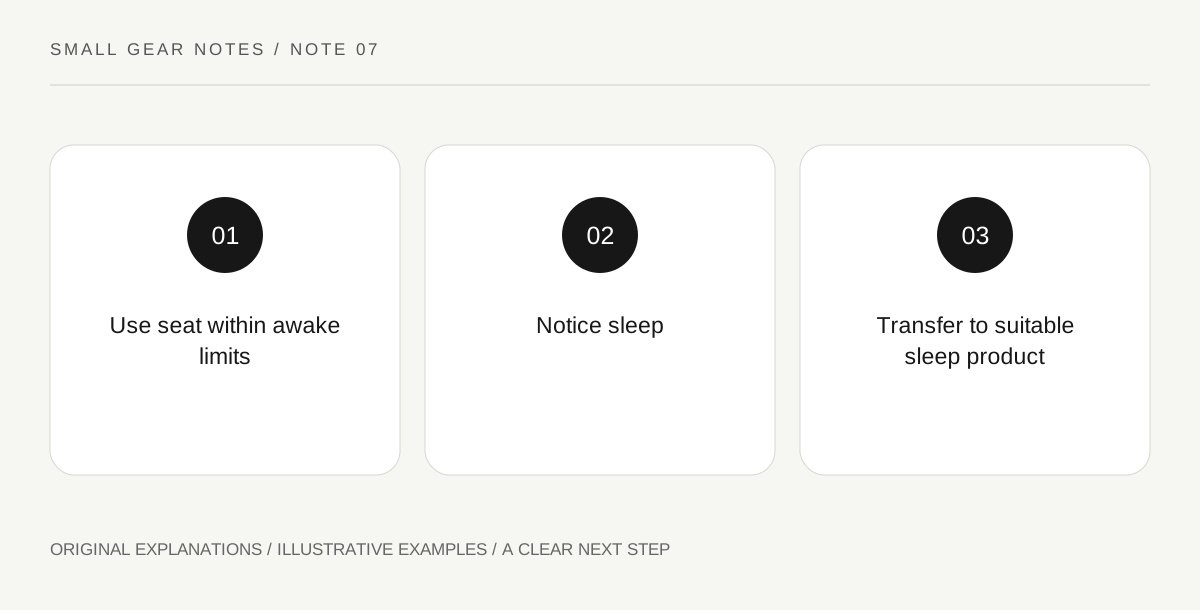
Original explanatory diagram. Read the full method and limitations below.
Read the purpose before the feature list
Identify whether the product is a bouncer, swing or another seat, and read its manual's warnings. Motion, music and reclining positions can dominate advertising, while the allowed use is explained in smaller instructions. CPSC advises moving a baby who falls asleep in a seated or similar product to an appropriate firm, flat sleep surface. Do not treat the deepest recline, an infant insert or the phrase supervised rest as a substitute for a product that meets the relevant infant sleep requirements.
Arrange the seat within its own limits
For awake use, follow the instructions for the child's weight, ability, restraint and placement. A seat belongs only on the surface the manual allows; placing it on a counter or table adds a fall hazard. Do not prop it with a cushion, hang it from furniture or add a head-positioning accessory. The harness is important for its intended task but cannot correct an unsuitable sleep posture. Check for damage, missing parts and recalls before first use, and stop when a stated developmental or size limit is reached.
Consider the seat's exit operation while comparing products. An adult should be able to release the restraint and lift the baby out using the instructed sequence without first moving the occupied seat to a higher surface. Practise controls while the product is empty and ask the manufacturer about a release that jams or needs unusual force. A convenient motion feature is less useful if the household routinely struggles with the basic transfer. The comparison should reflect the whole permitted use, including its ending.
Make a transfer route available
Before starting a soothing session, know which suitable crib, bassinet or play yard is ready for sleep. Keep its surface clear and use its instructed mattress arrangement. If you are alone, organize nearby supplies so you can attend to the baby without leaving them in the seat while assembling the next product. A transfer may interrupt the soothing effect, but that does not make continued sleep in the seat an appropriate solution. Discuss persistent settling difficulties with a qualified clinician rather than changing the seat's angle or adding padding.
Avoid supervision as a product modification
Watching a baby does not change the equipment's design or remove the risk of an obstructed airway. Video monitoring is also not a substitute for an appropriate sleep environment. Tell other caregivers the product's awake-use boundary, especially when a baby commonly becomes drowsy during motion. Do not use a cover to make the seat darker or quieter if it is not an approved component. When comparing products, evaluate whether their permitted use fits your actual routine instead of paying for a feature you intend to use outside its instructions.
A familiar evening pattern
Illustrative example: a baby often becomes sleepy during a short swing session. The caregiver prepares the crib first and makes the transfer when sleep occurs, even if the baby wakes. They ask the clinician about ongoing settling concerns rather than purchasing an extra insert advertised to hold the head upright.
Practical checks
Optional checkboxes save only in this browser.
Questions that come up
Does a harness make sleeping in a swing appropriate?
No. A restraint serves the seat's intended use and does not transform a seated product into a suitable infant sleep surface.
What if I can watch continuously?
Supervision does not change the product's intended purpose or eliminate airway hazards. Follow official transfer guidance and the exact manual.
References and scope
These sources support the factual background. Examples and exercises are original illustrative teaching material. References do not imply endorsement.
- CPSC baby safety checklist — Missing crib hardware, high-chair restraints, bathing aids and small-object hazards.
- CPSC safe sleep information — Appropriate sleep products, transfer from seated products and a clear firm flat surface.
- CPSC infant sleep product questions — Sleep marketing, supervised-sleep claims and mandatory standards.