Read a toy's age label as a safety boundary, not a development score
A baby who reaches early for a sibling's toy has not outgrown that toy's safety warning. Age grading considers product characteristics and hazards, while individual interest is a different observation. Compare the label, actual parts and household access without treating a higher age number as a mark of developmental achievement.
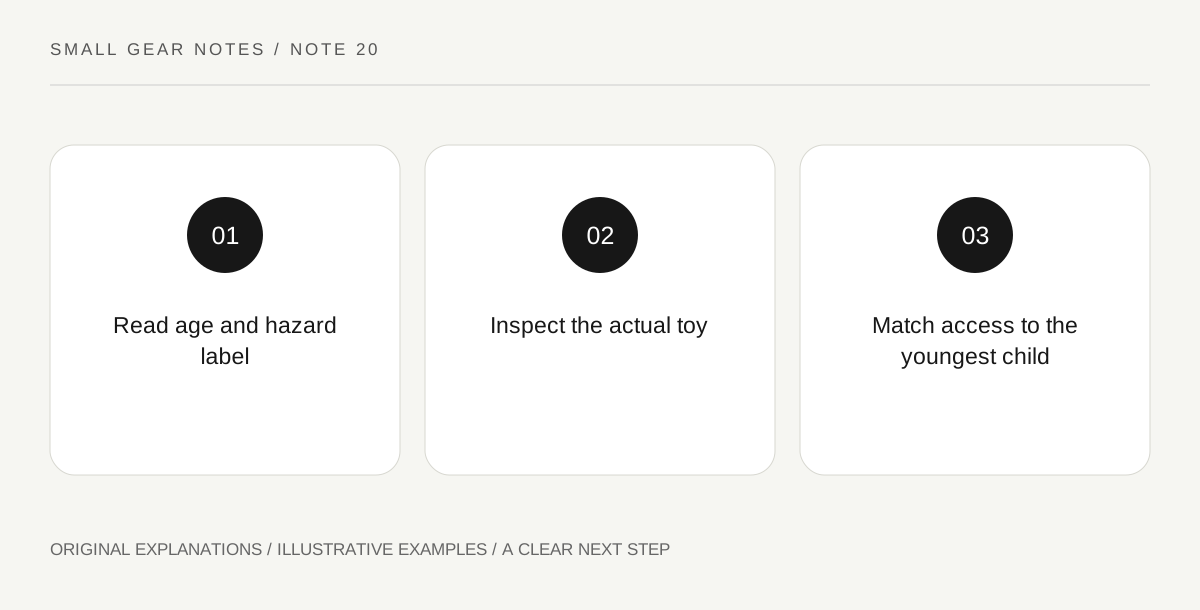
Original explanatory diagram. Read the full method and limitations below.
Separate interest from permitted use
A younger child may be fascinated by a detailed puzzle, tiny vehicle or construction set intended for older children. That interest does not remove small-part or other product hazards. Read the age label and warnings before introducing a toy, including gifts selected for an imagined future stage. Do not frame an older age range as a challenge the child should pass. Choose a suitable object that supports the same kind of curiosity, such as looking, grasping or exploring sound, without providing components that are inappropriate for the child's age.
Inspect the actual components and condition
Check the toy itself, not just its original box. Loose eyes, wheels, caps, fasteners or broken pieces can change the hazard after purchase. CPSC's toy requirements include small-part protections for products intended for children under three, but a caregiver should still remove damaged products and keep older children's small pieces inaccessible. Do not test a questionable part in a child's mouth or use supervision to justify an inappropriate toy. If a product cannot be identified and its warnings are missing, resolve those gaps before offering it.
Give gift givers a practical description of the current boundary, such as an age-appropriate toy without small detachable components, rather than asking for something advanced. When a gift is intended for a later age, store it securely with its instructions until it becomes appropriate. Remove wrapping, ties and other packaging according to the product directions before play. A suitable toy can acquire an unsuitable loose piece during unpacking, so the first inspection belongs between opening the package and handing the object to the child.
Plan shared-room access
A family may have several age groups in one room, so the oldest child's permitted toy collection cannot automatically become the baby's accessible collection. Use secure storage and a clearly separated activity area for small components. Clean up before the baby returns, checking under cushions and furniture as well as the obvious table surface. Balloons and their broken pieces also deserve particular care because of choking hazards. An older child can help learn the routine, but an adult remains responsible for deciding what is accessible.
Compare claims with ordinary play value
Words such as advanced, educational or developmental do not override safety labels or establish a guaranteed benefit. Ask what the child actually does with the toy and whether an age-appropriate alternative offers a similar experience. Keep the manufacturer and model information so you can review recalls and obtain instructions for battery compartments or detachable pieces. A toy can be simple and useful without offering an ambitious learning promise. Retire a toy when damage or missing components prevent safe instructed use, rather than preserving it because the child is attached to it.
A sibling's miniature set
Illustrative example: a baby watches an older sibling arrange tiny animal figures. The family keeps that set in a separated area and offers the baby suitable larger play objects instead. The baby's interest becomes a cue for shared conversation, not evidence that the age warning can be ignored.
Practical checks
Optional checkboxes save only in this browser.
Questions that come up
Can close supervision override a small-parts warning?
Do not use supervision to justify an age-inappropriate toy. Choose a suitable alternative and control access to older children's components.
Does a higher age label mean better learning?
No. It describes intended use and can reflect safety considerations. It is not a ranking of a child's ability or a guarantee of educational value.
References and scope
These sources support the factual background. Examples and exercises are original illustrative teaching material. References do not imply endorsement.
- CPSC toy safety guidance — Age-related toy requirements, small parts, testing and tracking labels.
- CPSC baby safety checklist — Missing crib hardware, high-chair restraints, bathing aids and small-object hazards.